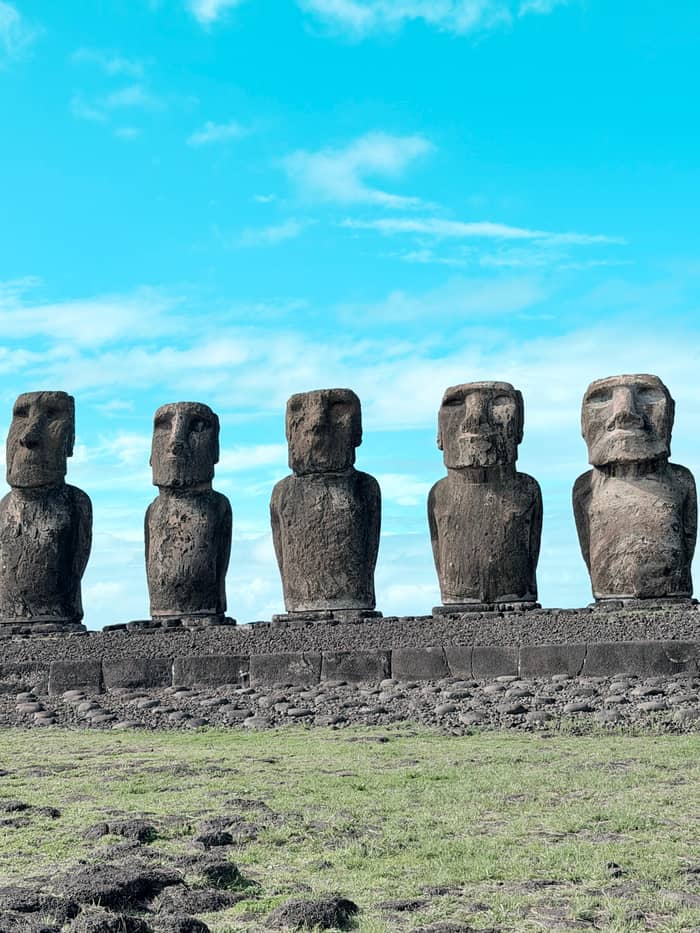
Start of every road
Rano Raraku
The quarry slopes
- WhatStatues at every stage
- On the tourGuided walk
- TipAsk about road moai
Help me decide
Two questions, one way to see it
Choose how you want to explore the transport story, and a tour appears with its starting price.
Best for you
from $80
A guided walk of 1 hour at Rano Raraku inside an 8-hour day with pickup.
Best for you
from $142
1 hour at Rano Raraku plus lunch on site, then Anakena.
Best for you
from $70
8 hours, limited to 14 participants.
Best for you
from $100
2 hours, a private group, with an instructor who speaks Spanish.
Best for you
from $294
6 hours for your group, 3 of them at Rano Raraku, plus Tongariki, Anakena, Akivi and Orongo.
The Rapa Nui always said the statues walked from the quarry. For a century outsiders preferred sledges and rollers. Then a replica took its first steps, and the roads began to make sense.
Editorial team, easterislandtour.quest · Updated November 11, 2026 · Takes 7 min
The essentials
Every visitor who stands below a moai asks the same question: how did a statue of many tons travel kilometers from the quarry to a platform by the sea, on an island without draft animals or wheels? The University of Arizona's summary of the latest study notes that the transport of the moai has been argued over for more than a century,5 and few debates in Pacific archaeology have been so public or so heated.
The National Library of Chile states the problem plainly. Once a statue was finished at Rano Raraku it was moved to its ahu by a method that is not known, then raised on the platform, an effort that demanded many people, much time and materials such as picks, ropes and timber.6 That honest gap is the space into which every theory, sensible or wild, has been poured since European ships first arrived.
Chile Travel lists the wildest of them with a raised eyebrow, from priests moving stone by thought to visitors from other worlds, and then notes that several island myths say the statues simply walked to their places.7 For a long time outsiders treated that tradition as poetry. The story of the walking moai of Rapa Nui is partly the story of taking it seriously.
The ideas compared
| Method | How it works | Evidence offered |
|---|---|---|
| Walking upright | Rocked side to side by teams | Road statue shapes, oral tradition |
| Wooden sledge on logs | Laid flat and hauled | Timber once grew on the island |
| A-frame sledge | Carried at an angle | A replica moved for television |
Summarized from the University of Arizona study page, Chile Travel, the National Library of Chile and the Easter Island Statue Project.3,12,13,10
For most of the twentieth century the favorite explanation was horizontal transport. Chile Travel summarizes it as the theory held by most researchers: each moai was laid on a kind of wooden sledge, run over logs and hauled with ropes across the island.12 It is an image that appears in countless school books and documentaries, and it fits a picture of a society pouring its forests into monument building.
Timber was certainly part of island life. The library records that woody species such as the toromiro, sandalwood and a palm grew on the island when the Polynesian settlers arrived, and that their wood was used for building, fuel, ritual carvings and probably for moving the moai.13 The same history tells how near-total deforestation later left the islanders unable even to build boats.14
Experiments followed the theory. In 1997 the Easter Island Statue Project, led from UCLA, carved and moved a replica for the NOVA series on lost empires.9 Its design was a wooden A-frame sledge modeled on the ladder of a Polynesian canoe,10 in keeping with the project's view that statue carving is best understood through the specialist craft of canoe building.15
The walking hypothesis turns the problem upright. Instead of laying a statue down, a team keeps it standing and rocks it from side to side so that it shuffles forward, the way you might walk a heavy refrigerator across a kitchen floor. The idea had circulated for decades, but earlier upright trials used replicas shaped like the finished statues on the platforms, and they struggled.
The archaeologists Carl Lipo and Terry Hunt built a different replica for their Easter Island moai walking experiment. It was precisely scaled on the road statues rather than the platform ones, weighed 4.35 metric tons, and a team of 18 people moved it 100 m in 40 min.2 They report that the forward lean of the design was what made the motion efficient, a clear advance on the upright attempts that came before.
Their full case appeared in 2025, in volume 183 of the Journal of Archaeological Science.11 They argue that the walking method needed very few resources and little labor compared with dragging statues flat,18 which, if right, changes how we read the island's past: less a story of forests destroyed to drag stone, more one of clever engineering by a small community.
Where the argument lives
Start of every road
The quarry slopes
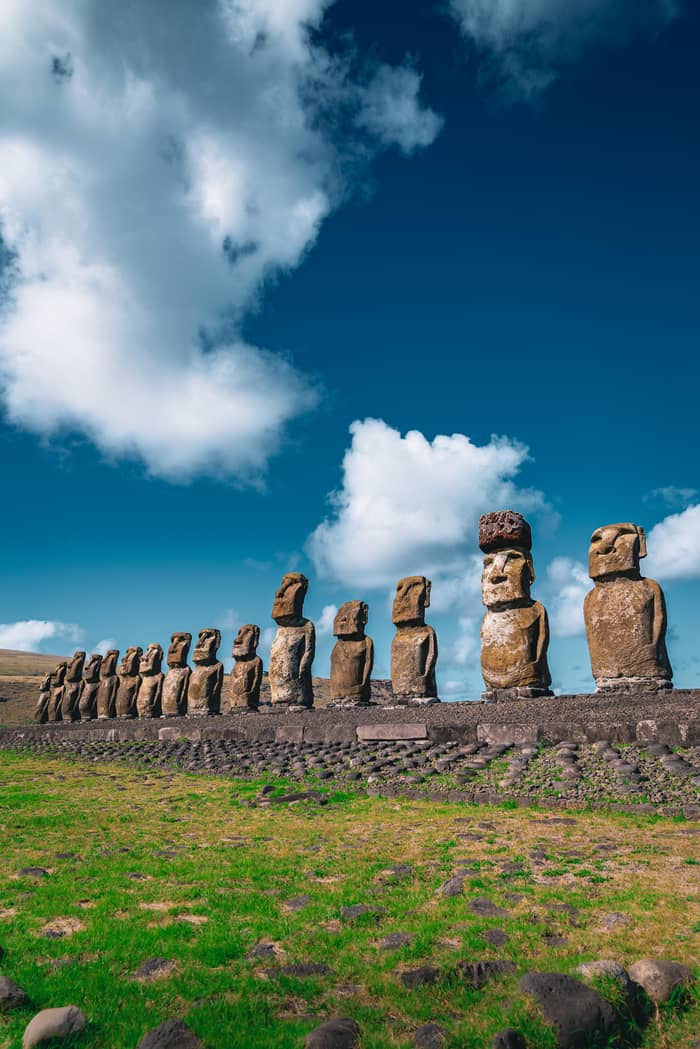
Fallen on the way
Below the quarry
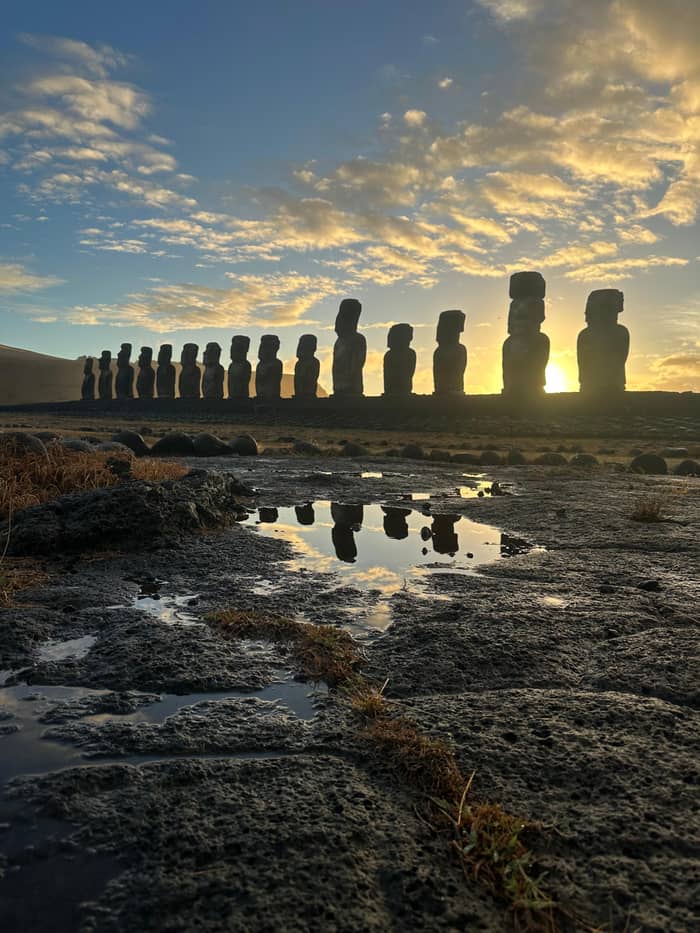
Journey's end
The coast
The strongest evidence is not the replica but the statues left behind on the way. Lipo and Hunt analyzed 962 moai and paid particular attention to 62 road statues, combining field records, 3D models and trials.16 These are figures that lie along ancient routes from the quarry, never set on any platform, and they look different from the statues that reached the coast.
Road moai, the study reports, have wide, D-shaped bases and lean forward, while the ancient roads themselves are about 4.5m wide with a concave, slightly dished cross-section.3 A shape like that suits a statue rocking upright down a shallow channel far better than a sledge dragged on the flat, and the breakage on fallen road statues follows patterns the authors link to tipping in motion.
Distance tells the same story. According to the same summary, 51.6 % of the road moai lie within 2 km of Rano Raraku, falling away with distance in the way expected when objects fail in transport rather than being placed on purpose.17 Chile Travel describes the slopes of the quarry itself as littered with statues that broke or fell on the move and were left where they lay.23
Go with a guide
Compare guided days that include Rano Raraku.
Compare all 3 options
Compare guided days that include Rano Raraku.
≈
View≈
View≈
ViewStarting prices on GetYourGuide, exchanged at the ECB reference rate. The booking page gives the exact price.
The transport question
Oral tradition
Rapa Nui accounts describe moai walking from the quarry.1
1955 to 1956
Thor Heyerdahl's team raises fallen moai again.8
1997
2025
Lipo and Hunt publish their case for upright transport.11
Today
Critics still question terrain, rope and weathering.4
Not everyone is convinced, and it would be unfair to pretend otherwise. The study itself acknowledges that several scholars have challenged the walking idea, raising questions about rough terrain, whether enough rope existed, how the stone weathered and whether other methods fit the evidence just as well.4 Each Easter Island moai transport experiment so far has proved that a method can work, which is not quite the same as proving it did.
The rival approaches also answer slightly different questions. A sledge can carry any shape, while walking needs a statue designed for it, so the D-shaped bases are either the decisive clue or a coincidence, depending on whom you ask. The road statues may also have traveled in more than one way over the centuries of carving, and the official histories of the island still describe the method as unknown.6
What has changed is the weight given to Rapa Nui knowledge. The authors present their results as matching the oral traditions that describe moai walking from the quarry,1 and that is the point most guides on the island will make to you at Rano Raraku. Listen to the story as it is told there; it may yet prove more accurate than many confident outsiders.
Video
National Geographic on YouTube · The video only starts loading on your tap.
51.6 % concentrate within 2 km of the Rano Raraku quarry, following an exponential decay pattern expected from mechanical failure processes rather than deliberate ceremonial placement.
At the quarry
Searchers often ask how did the moai get to Easter Island, as if the statues had been shipped in. They were not: every moai was made on the island, overwhelmingly from the tuff of Rano Raraku. Chile's heritage council describes that rock as a lapilli tuff, a soft volcanic conglomerate that was easy to work and allowed the ancestors to carve the moai and spread them across the island.24
The people came first, by sea. The National Library's history tells of settlers arriving from the Marquesas around the year 600,25 and of specialist carvers who later cut the statues at the quarry on behalf of each lineage.26 The real journey, then, is the short one across the island, from the crater walls to a platform near each clan's coastal land.
That short journey is still visible. Of the 1,042 carved objects the Easter Island Statue Project had catalogued, it traces fully 95% to Rano Raraku,27 so nearly every moai you see on a platform began life on the same hillside and made the walk, or the haul, from there.
The best place to think about transport is the quarry, where unfinished and abandoned figures lie at every stage. The culture day sold on this site spends 1 hour on a guided walk at Rano Raraku before Ahu Tongariki, Te Pito Kura and Anakena, with pickup in Hanga Roa, from $80. Ask your guide to point out statues lying along the old routes below the slope.
Remember the rules. Rano Raraku can be entered only once on each park ticket,20 so make the visit count, and you may not climb, sit on or lean against any statue or platform.21 Fallen moai are part of the record; the way a statue broke can be evidence, and the park asks that every stone stays exactly where it is.28
For a hands-on view of the craft, one listing offers a private demonstration of how a moai is carved, 2 hours with an instructor who speaks Spanish, from $100. Pair it with the quarry and the experiment stops being an abstract argument: you will see how the stone was cut, and then where it was asked to walk.
FAQ
Their study appeared in the Journal of Archaeological Science, volume 183.11
A moai lying along an ancient route from the quarry, with a wide D-shaped base and a forward lean.3
Chile Travel describes it as a wooden sledge run over logs and pulled with ropes.12
Over half of the road moai lie within 2 km of the quarry, along the old routes below its slope.17
The park ticket covers just one entry to Rano Raraku, so choose a clear day.20
Sources
More to read
Planning a day among the moai? Ask a real person here.