Where they began
Rano Raraku
The quarry
- What you seeStatues at every stage
- On the tourGuided walk
- RuleOnce per ticket
Help me decide
Two questions, one moai day
Say how much time you have and what matters most, and a tour appears with its starting price.
Best for you
from $80
8 hours with pickup: Akahanga, Rano Raraku, Tongariki (optional), Te Pito Kura and free time at Anakena, guides in English and Spanish.
Best for you
from $70
8 hours with pickup, limited to 14 participants, guides in English and Spanish.
Best for you
from $142
8 hours: Tongariki, 1 hour at Rano Raraku, lunch there, then Anakena.
Best for you
from $82
3 hours: Ahu Akivi, Puna Pau and the sunset at Ahu Tahai, groups of up to 15.
Best for you
from $170
2 days with pickup, groups of up to 14, wheelchair accessible.
They are not heads, and they were never decoration. Here is what the moai mean to the Rapa Nui people, how they were made, and how to stand before them with respect.
Editorial team, easterislandtour.quest · Updated November 11, 2026 · Takes 7 min
The essentials
The moai of Rapa Nui are human figures carved from a single block of stone, set on ceremonial platforms called ahu. Photographs of the heads at the quarry have taught much of the world to call them Easter Island heads, but nearly every moai has a full torso, arms carved flat against the sides and long hands meeting over the belly. Chile Travel says plainly that thinking of them as giant stone heads is simply wrong.5
For the Rapa Nui people they are something more than sculpture. The National Museum of Natural History, writing when it returned a moai to the island, explains that each statue stands for the spirit of the ancestors, carries their energy and is regarded as a living embodiment of a person.1 That is why the park asks you to keep your distance and why a family may speak of a moai by name.
Chile Travel admits that nobody can say with certainty why they were raised, though most accounts point to religion: tributes to forebears who, after death, were believed to protect their clan.6 Archaeologists describe the ahu as the island's version of the ceremonial courts found across central Polynesia, where gods and ancestors were honored on a raised altar.7
Counting the moai
| Source | Count | What it counts |
|---|---|---|
| Park administration | 900+ | Moai on the island |
| Chile Travel | 900 | 400 at the quarry, 288 on platforms |
| Chile Travel excursions | 887 | Monumental statues |
| Chile's UNESCO statement | 800+ | Statues preserved today |
| Statue Project, UCLA | 1,300 | Every carved object and fragment |
Each count measures something slightly different; none is wrong.2,18,15,16,17
Ask how many moai are on Easter Island and you will hear several honest answers, because each count measures something different. The park administration gives a round figure of more than 900.2 A Chile Travel article on excursions uses 887,15 and Chile's statement to UNESCO speaks of more than 800 preserved statues, around a third of them standing on, or fallen from, an ahu.16
Survey archaeologists count every fragment as well. The Easter Island Statue Project, run from UCLA, has logged 1,300 carved objects across the island, in museums and in the quarry, including heads, torsos and shaped blocks that never became statues.17 The bigger number is not a contradiction; it simply includes pieces that a visitor would never recognize as a moai.
The single most striking figure is where they are. Chile Travel puts 400 at the Rano Raraku quarry and 288 on platforms, with the rest scattered over the island.18 So close to half of all the statues never left the volcano where they were carved, which is why a visit to the quarry teaches more about the moai than any other stop.
The answer to who built the moai statues on Easter Island is the Rapa Nui themselves, the descendants of Polynesian voyagers. The National Library's history of the island tells of Marquesan voyagers who landed around the year 600, led according to oral tradition by the ariki Hotu Matu'a, whose sons founded the island's lineages.22,23
Carving was skilled, specialist work. The library names the carvers tangata maori anga moai maea, craftsmen to whom each lineage entrusted a statue at the Rano Raraku quarries.4 A statue was a statement of a clan's strength, and the competition between lineages pushed them to carve ever larger figures, as the same source records.24
The conservation center of Chile's heritage service places the main carving age, which it calls the Ahu-Moai period, between 1000 and 1500 AD.9 Nearly all the statues of that age came from the slope of the volcano.9 Building began earlier: the library dates the oldest ceremonial platform, Ahu Tahai beside today's Hanga Roa, to the year 713 AD.8
Where to meet them
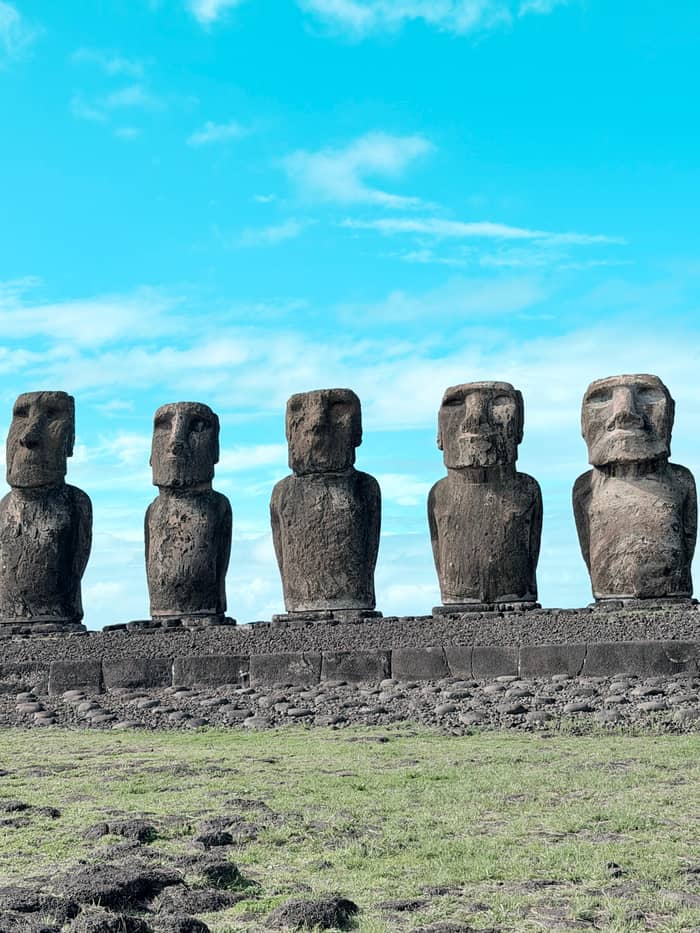
Where they began
The quarry
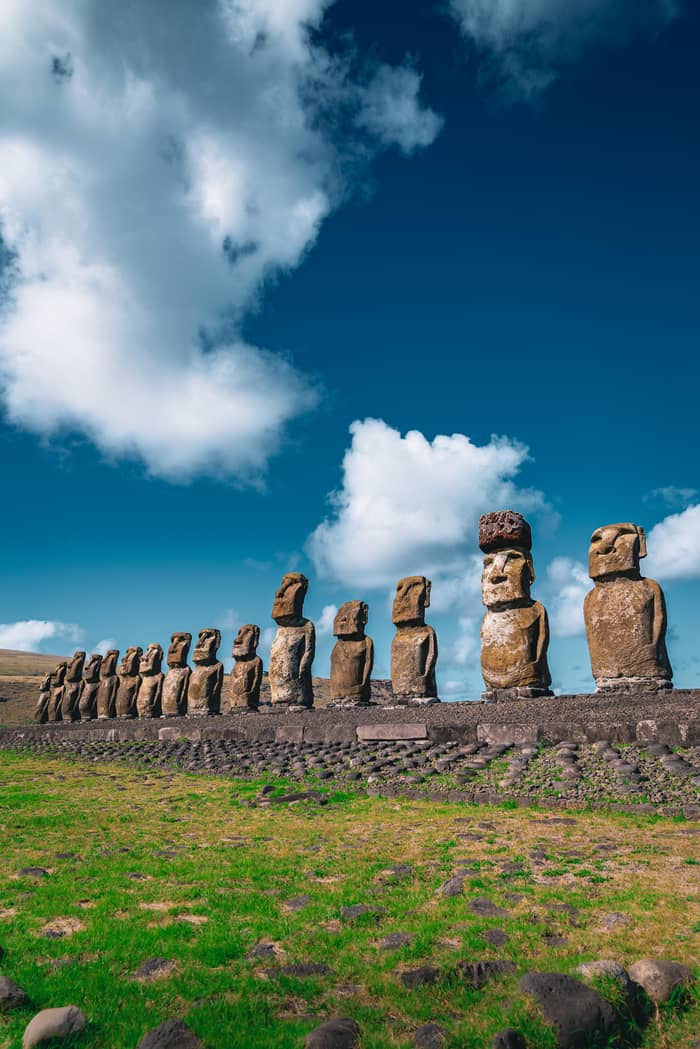
With topknots
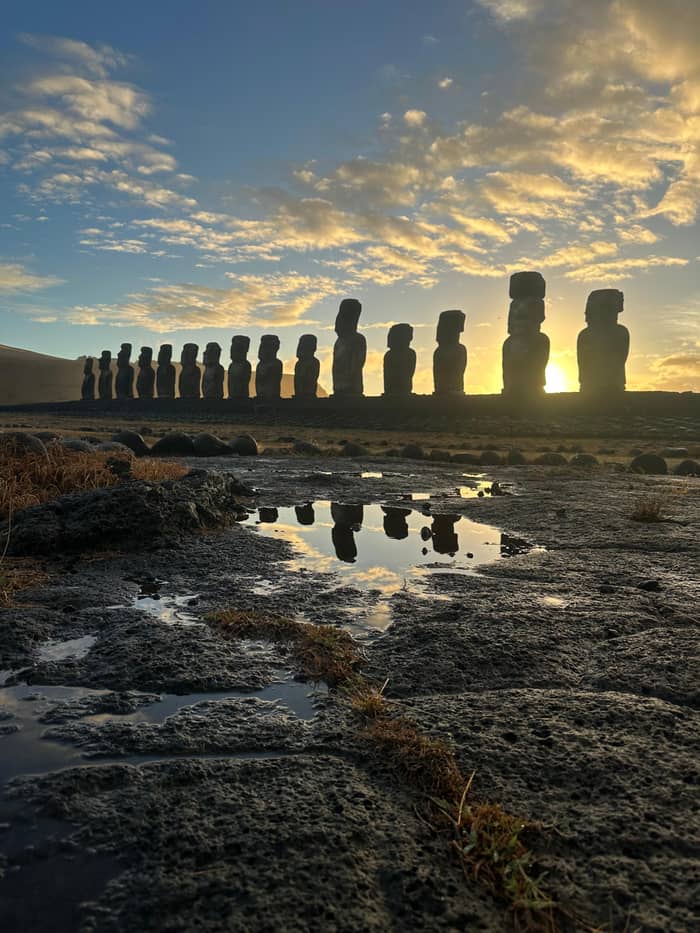
Anakena beach
Back home
Museum in Hanga Roa
Sizes vary far more than postcards suggest. The library gives an average of 4.5 meters and about 40 tons,3 while Chile Travel describes most as roughly 4 meters high.21 The conservation center's own range is 3.5 to 5 meters and 50 to 60 tons,29 a reminder that weights are estimates for stone that nobody can put on a scale.
At the top end stand the statues that tested what the carvers could move. Paro, at Ahu Te Pito Kura, is the tallest ever set on a platform, 10 meters and an estimated 90 tons by the conservation center's figures.20 The park describes it as the largest statue ever transported from the quarry, crowned by a huge pukao.30
The true giant never left the rock. An unfinished figure in the quarry runs to 21.6 meters by the library's measure, with a weight above 200 tons,19 while Chile Travel, naming it Te Tokanga, puts it at more than 21 meters and above 270 tons.31 The sources disagree on the weight, so we show both. Either way, it still lies where it was carved.
Go with a guide
Compare guided days that reach the main moai sites.
Compare all 4 options
Compare guided days that reach the main moai sites.
≈
View≈
View≈
View≈
ViewStarting prices on GetYourGuide, exchanged at the ECB reference rate. The booking page gives the exact price.
A short chronology
713 AD
Ahu Tahai, the earliest dated platform, is built.8
1000 to 1500
Nearly every statue is cut from Rano Raraku.9
1500 to 1722
1870
Moai Tau is shipped to Santiago on the O'Higgins.12
1978
The largest complete moai eye is found.13
7 March
The statue lands on the island after 152 years.14
A finished moai on its ahu had one last element. The library describes the key moment of the ritual as fitting small eyes, which it says were of obsidian, into the sockets, and those eyes were what gave the figure its mana, its power.32 The museum on the island shows the largest complete moai eye ever found, recovered in 1978 while Ahu Nau Nau at Anakena was being restored.13
Some statues also wore a cylinder of red scoria on the head, the pukao.33 The park identifies Puna Pau as the small crater quarry where most of them were cut, and unfinished pieces still lie on its slopes.34 At Anakena the moai of Ahu Nau Nau still carry theirs, which makes it the easiest place to picture a complete platform.35
Style changed over the centuries. Chile Travel notes that the earliest figures are smaller, with rounded heads and bodies, and that later ones grew slimmer and straighter, with larger ears and long noses.36 Most were cut from volcanic tuff, while a few used red scoria or basalt,37 which explains why the small basalt moai returned from Santiago looks so unlike the tuff giants of the quarry.
Video
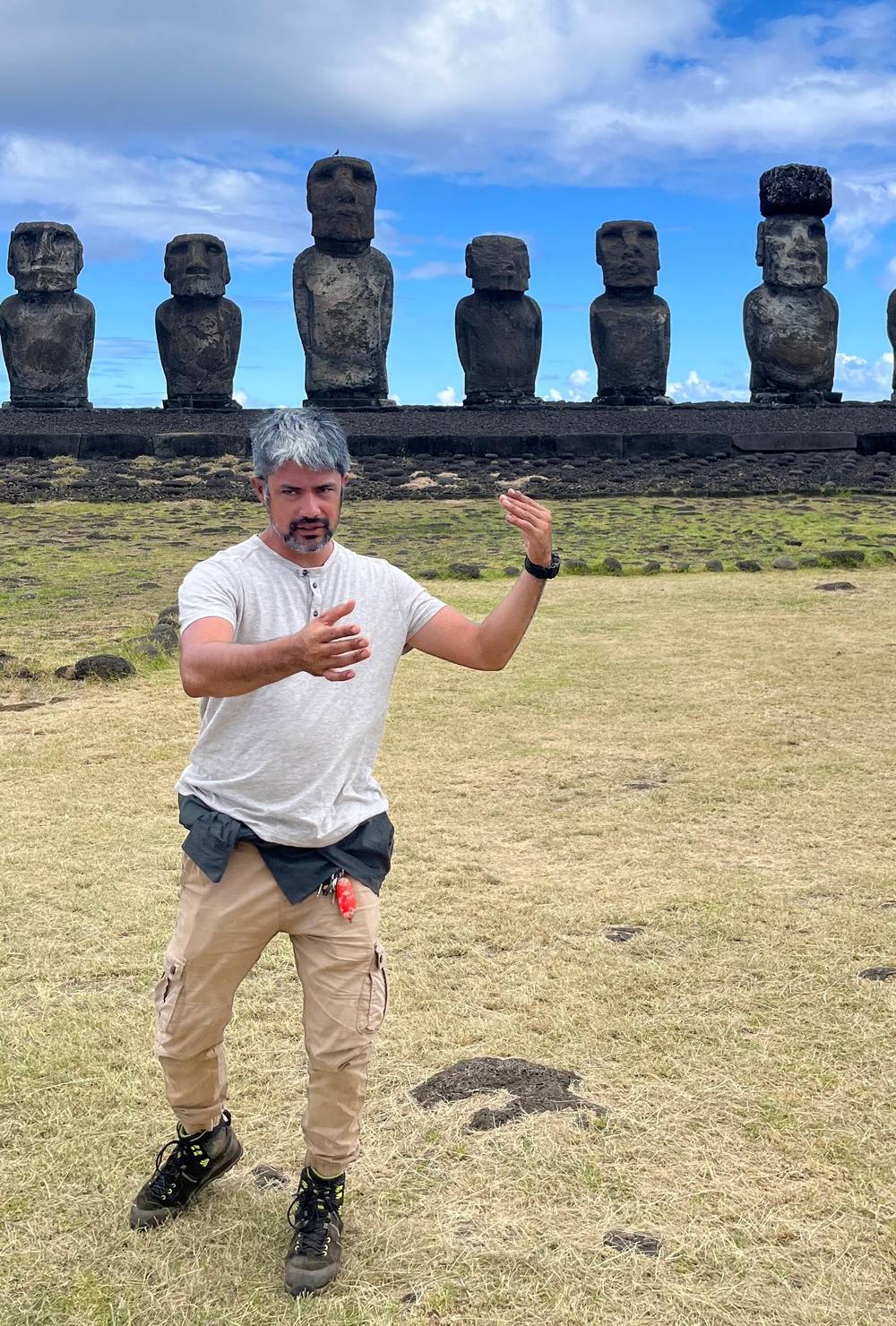
NOVA PBS Official on YouTube · The video only starts loading on your tap.
For the Rapa Nui people, the moai represent the spirit of their ancestors, hold ancestral energy and are considered the living embodiment of a person.
Before you go
No platform was standing when the restorers arrived. The conservation center describes a period of social breakdown from 1500 to 1722, the Huri Moai, when almost every figure on the ahu was pushed over and broken.10,11 The moai you see upright today were raised again by restorers, beginning with Thor Heyerdahl's team in 1955 and 1956.38
Moai have also traveled. One was taken to Santiago in 1870 aboard the corvette O'Higgins and shown at the National Museum of Natural History from 1878.12,39 Known as Moai Tau, it is a basalt figure of 715 kilos,40 and it landed back on the island on 7 March, after 152 years away, under a repatriation program for ancestral remains and sacred objects.14,41
It now stands in the anthropological museum named after Father Sebastian Englert, in Hanga Roa.42 Other moai remain in collections abroad, and their return is a live question for the Rapa Nui community. The museum building itself has a moai link: its permanent hall was paid for by Japanese donors in thanks for the loan of a statue to Osaka.43
Every Easter Island moai stands inside Rapa Nui National Park, and the park sets clear terms. Entry requires a park ticket plus a guide holding Ma'u Henua accreditation; Ma'u Henua is the indigenous community in charge of the park.25 Look at the statues and the ahu from the marked distance, never touching or leaning on them,27 and remember that breaking the rules can mean a fine of 5 to 100 UTM under the national monuments law.44
The guided day sold on this site is an easy way to meet the greatest number of moai in one outing. It runs for 8 hours with pickup in Hanga Roa, with native guides speaking English and Spanish, and stops at Akahanga, Rano Raraku, Ahu Tongariki, which the listing marks optional, Te Pito Kura and Anakena, from $80.
Plan at least one quiet hour beyond the tour. Read the plaques at the museum, look for the eye from Anakena, then go back to a platform at a different time of day. The moai change with the light, and much of what you learn on a guided day only settles once you stand in front of them again on your own.
FAQ
A human figure cut from one block of stone and set on an ahu; for the Rapa Nui it carries the spirit of a forebear.1
Many statues at the quarry are buried from the torso down, which is why many travelers wrongly think they are only heads.5
Sources
More to read
Planning a day among the moai? Ask a real person here.