Sold here
Culture day
Shared, 8 hours
- At the quarry1 hour
- AlsoTongariki, Anakena
- GuidesEnglish, Spanish
Your stop on the map
Browse 20 stops
Start by picking a route; tap a pin or stop for its note and Google Maps.
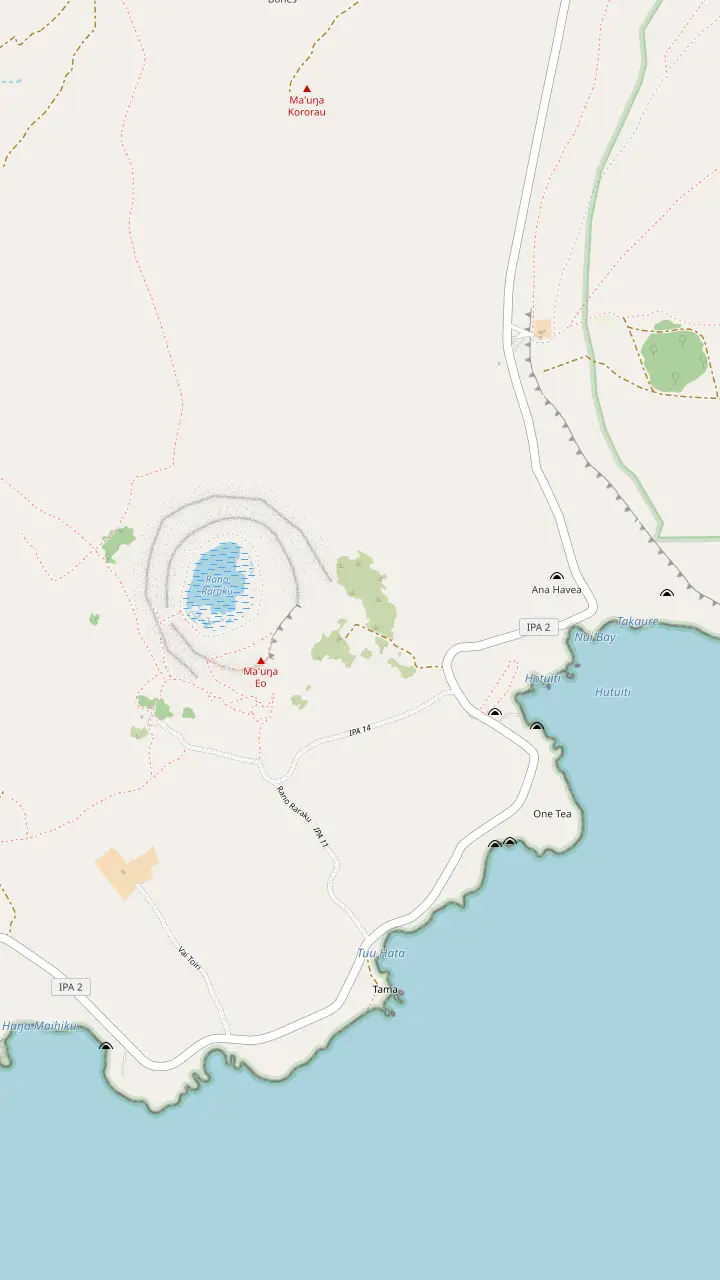
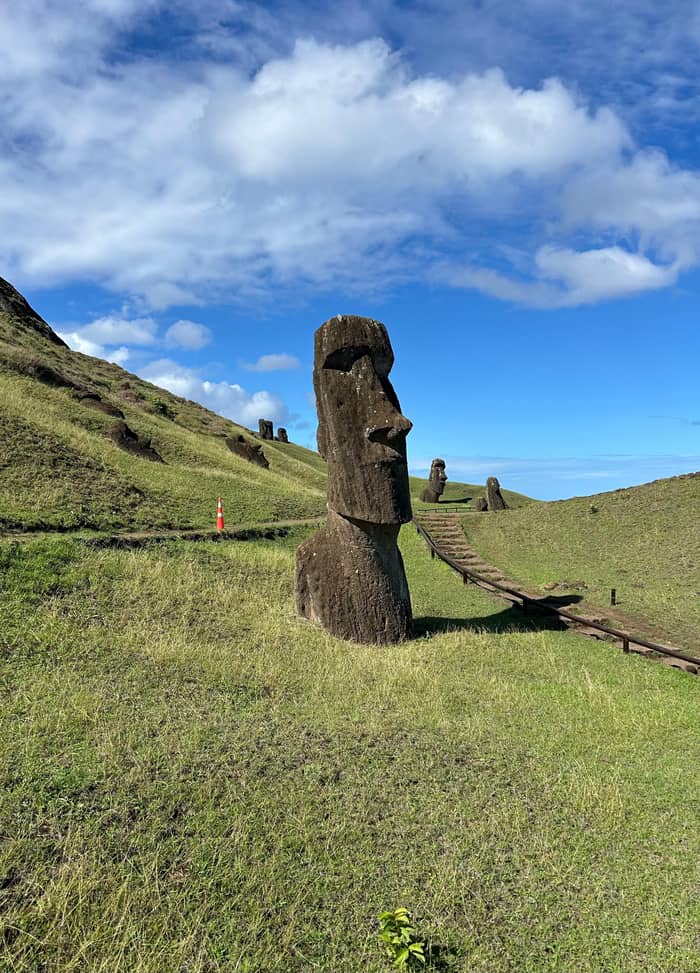
The volcano where the moai were carved: the park counts 400 statues in every stage of work on its slopes and in its crater.
Google MapsThe kneeling moai of Rano Raraku, also restored by Heyerdahl's team in 1955 and 1956.
Google MapsThe freshwater lagoon inside the Rano Raraku crater, reached on the walk past the half-buried heads.
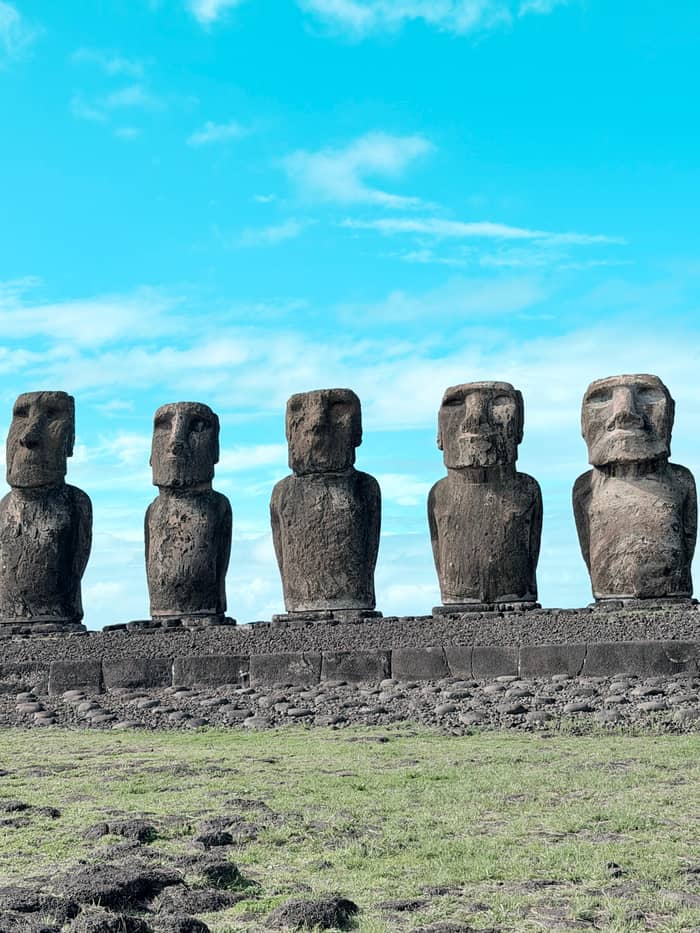
Google MapsThe largest platform on the island, 15 restored moai with their backs to the Pacific, and the classic sunrise spot.
Google Maps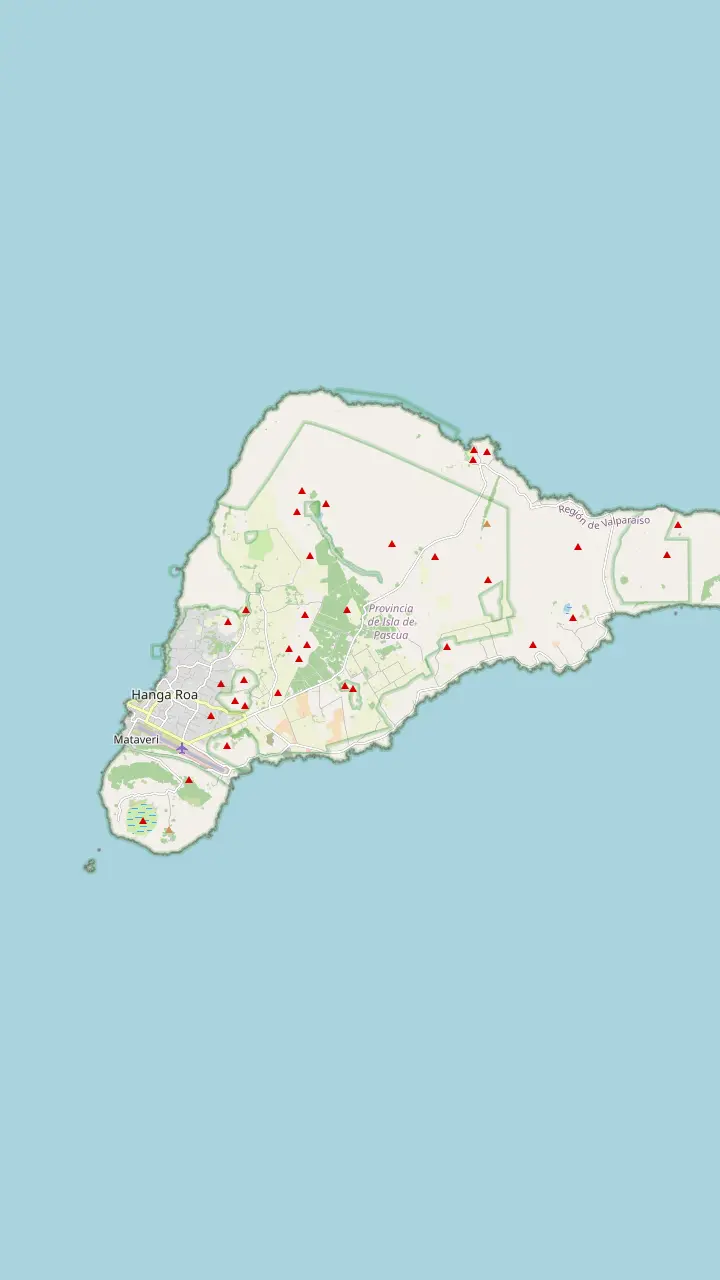
The island's only town and the start of every tour; the airport sits beside it, and green turtles swim in the cove among the fishing boats.
Google MapsThree restored ahu and the remains of a village, steps from town; the park calls it one of the best places on the island for sunset.
Google MapsSeven moai that look out to sea, aligned with the sun at the equinoxes, the platform linked to the explorers of the founding story.
Google MapsThe red scoria quarry where most of the pukao topknots were carved; unfinished pieces still lie there.
Google MapsTwo monumental ahu with fitted basalt walls that the park compares to Inca stonework.
Google MapsAn old village site with one of the longest platforms on the island and eight toppled moai.
Google MapsVillage remains and toppled moai by the sea; the park links them to the civil wars of the 18th century.
Google MapsThe volcano where the moai were carved: the park counts 400 statues in every stage of work on its slopes and in its crater.
Google MapsThe largest platform on the island, 15 restored moai with their backs to the Pacific, and the classic sunrise spot.
Google MapsHome of Paro, the largest moai ever moved from the quarry, with its huge pukao.
Google MapsThe platform behind Anakena beach, whose moai still wear their red pukao.
Google MapsThe stone village of the birdman cult on the rim of Rano Kau, with Motu Kao Kao, Motu Iti and Motu Nui out in the sea below.
Google Maps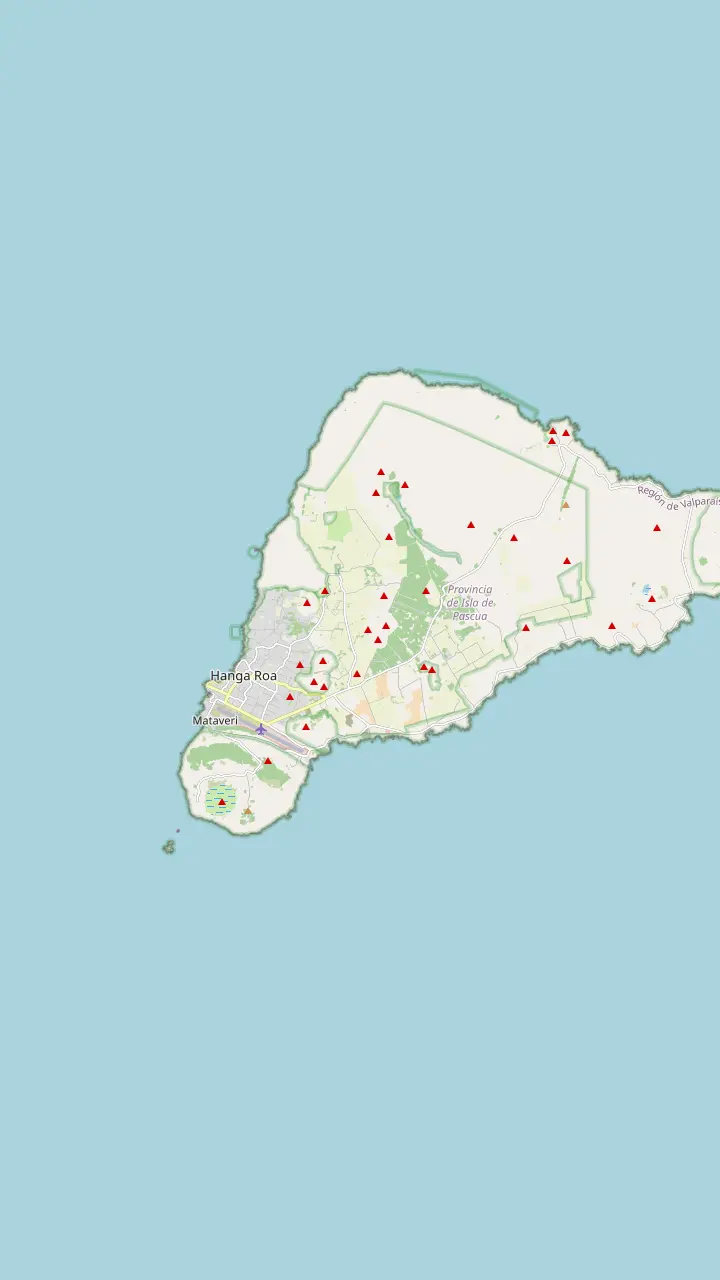
White coral sand and palms, and the place where oral tradition says King Hotu Matu'a came ashore.
Google MapsThe lone moai beside Anakena beach, raised again by Thor Heyerdahl's team in one of the first documented restorations.
Google MapsThe stone village of the birdman cult on the rim of Rano Kau, with Motu Kao Kao, Motu Iti and Motu Nui out in the sea below.
Google MapsOne of the islets off Orongo and the goal of the yearly race for the first manutara egg.
Google MapsThree restored ahu and the remains of a village, steps from town; the park calls it one of the best places on the island for sunset.
Google MapsThe anthropological museum named after the priest Sebastian Englert; the Moai Tau, returned from Santiago, is shown here.
Google MapsTwo monumental ahu with fitted basalt walls that the park compares to Inca stonework.
Google MapsThe island's only town and the start of every tour; the airport sits beside it, and green turtles swim in the cove among the fishing boats.
Google MapsMataveri International Airport, reached by the direct flight from Santiago of 5 hours and 30 minutes.
Google MapsThe small harbor where the Moai Tau was landed from a navy barge on its return in March.
Google MapsVillage remains and toppled moai by the sea; the park links them to the civil wars of the 18th century.
Google Maps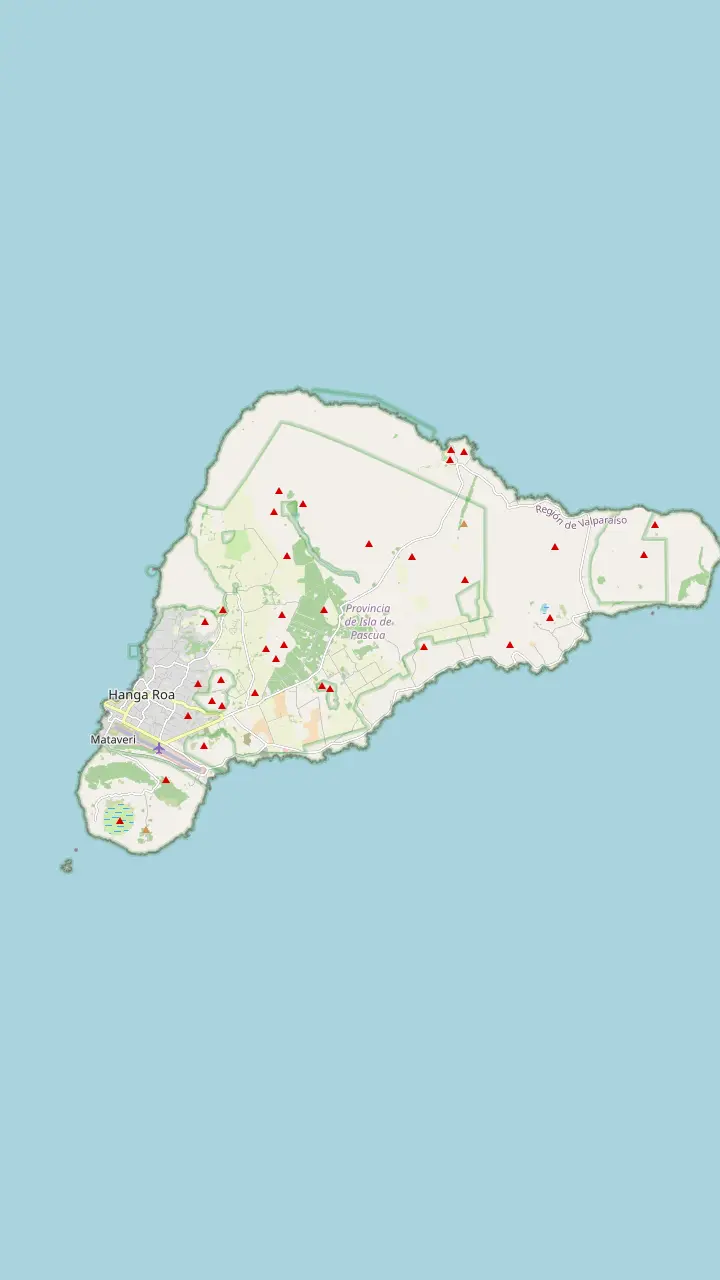
The largest platform on the island, 15 restored moai with their backs to the Pacific, and the classic sunrise spot.
Google MapsThree restored ahu and the remains of a village, steps from town; the park calls it one of the best places on the island for sunset.
Google MapsSeven moai that look out to sea, aligned with the sun at the equinoxes, the platform linked to the explorers of the founding story.
Google MapsThe island's only town and the start of every tour; the airport sits beside it, and green turtles swim in the cove among the fishing boats.
Google MapsThe volcano where the moai were carved: the park counts 400 statues in every stage of work on its slopes and in its crater.
Google MapsMap data: © OpenStreetMap contributors
On the slopes of one small volcano lie hundreds of moai at every stage of their making: heads buried to the chin, giants still joined to the rock, and a kneeling figure unlike any other.
Editorial team, easterislandtour.quest · Updated November 11, 2026 · Takes 7 min
The essentials
Rano Raraku is a small, grassy volcano on the southeast of the island, and almost every moai on Rapa Nui was cut from its walls. Chile Travel calls it the moai factory,5 and Chile's National Monuments Council explains why it was chosen: its slope is lapilli tuff, a volcanic conglomerate that forms a soft rock, easy to carve, the material that let the ancestors make the statues and send them all over the island.1
The numbers are remarkable for one hillside. The council counts 386 moai at Rano Raraku, 265 on the outer slope and 121 inside the crater.2 The park administration rounds the figure to 400 statues in different stages,6 and the Easter Island Statue Project, which surveyed the quarry stone by stone, reckons that fully 95% of the 1,042 carved objects it had recorded were made here.7
Those figures make the quarry the single most important place to understand the moai. Elsewhere you see finished statues on platforms, often restored. Here you see the whole process at once: outlines barely started in the rock, statues almost free of it, figures that slid down the slope and others standing upright in the soil, waiting for a journey that never began.
A visit follows a marked path up the outer slope among the half-buried heads, then turns into the crater, where a freshwater lagoon lies among more statues. From the outer slope the view runs down to the platform of Tongariki and the ocean,16 and the lagoon is one of only a handful of freshwater lakes on the island, as Chile Travel notes.17
Look out for the Moai Tukuturi, a kneeling figure that sits back on its heels, quite unlike the standard statue. It was one of the first moai restored in documented work, by Thor Heyerdahl's expedition in 1955 and 1956, together with the single moai at Anakena and a red scoria statue at Vinapu.10 Your guide will show you where it rests on the slope.
The climb is gentle but the ground is uneven and largely shadeless, and the path keeps you well back from the statues. Expect to stop often: each figure differs in face, size and state, and the guides of the Rapa Nui community tell the names and stories that belong to them. Take your time on the way up; the best views back across the slope come from the higher bends.
Statues on the volcano
Count by Chile's National Monuments Council.2
The most famous photographs of Rapa Nui show heads rising from the grass, and many travelers leave believing that the statues have no bodies. Chile Travel says firmly that this is wrong: at Rano Raraku several moai are simply buried from the torso down.3 Several of the best-known figures outside the quarry, it adds, stand sunk up to their shoulders.21
Excavation has shown how deep the soil runs. When the Mana expedition first dug around one quarry statue in 1914-15, it was buried to a line midway between the ear lobe and the angle of the jaw,9 and a trench at its back reached a depth of 16 feet from the crown of the head.22 Centuries of earth washing down the slope had swallowed the rest of the full body of an Easter Island moai.
Decades later the Easter Island Statue Project returned to the same statue with an all-Rapa Nui excavation crew.23 Its 2013 season ran from August 6 to August 29, after which the trenches were closed to protect them from heavy rain, with help from CONAF and the National Monuments Council.11 The statues were left as they were found: you see the heads, while the bodies stay safe underground.
Ways to see the quarry
Inside the quarry walls the unfinished moai of Easter Island lie where the carvers left them, many still attached to the bedrock, as Chile Travel puts it.5 You can trace the stages: a rough outline, a face and front cut while the back is still joined to the rock, then a figure ready to be freed. Others broke on the move or fell and were abandoned on the slope.49
The largest of all never left. The National Library of Chile measures this unfinished giant at 21.6 meters and more than 200 tons,18 Chile's conservation center gives 22 meters and about 250 tons,19 and Chile Travel names it Te Tokanga, at over 21 meters and more than 270 tons.20 We show every estimate because the weights are estimates for a figure that is still part of the mountain.
Why carve something that could never be moved? The library links the growing size of statues to rivalry between lineages,50 and the conservation center suggests that the carvers probably believed they could move it.51 Nobody knows, and that uncertainty is part of the quarry's power. Standing beside the giant, you are looking at an ambition frozen at the moment the work stopped.
Go with a guide
Shared days that include a guided walk at Rano Raraku.
Compare all 3 options
Shared days that include a guided walk at Rano Raraku.
≈
View≈
View≈
ViewStarting prices on GetYourGuide, exchanged at the ECB reference rate. The booking page gives the exact price.
The quarry through time
1000 to 1500
Nearly all moai are cut from the volcano.8
1914-15
A quarry statue is found buried to the jaw.9
1955 to 1956
Heyerdahl's team raises the kneeling moai.10
2013
Statue Project trenches are dug and closed again.11
October 2022
Today
In early October a fire swept the volcano. The National Monuments Council reports that it began on 4 October and was brought under control late on 5 October,52 burning about 60 hectares around Rano Raraku and reaching the slope where the moai stand.12 The park administration closed the site so the technical teams could record the damage safely.
Heat is a real danger to these statues. The council explains that fire makes the tuff expand and contract, which can open large fractures and threaten a moai's integrity.53 Ma'u Henua's archaeology team lists the fire of 2022 alongside natural erosion and organic growth as causes of an accelerated decay of the stone.13 The tuff also holds water: the conservation center notes that the statues never fully dry out.54
The response has been local and patient. Ma'u Henua selected five moai at Rano Raraku in the worst condition and treated them,14 applying consolidants to strengthen the surface and water repellents to cut the moisture the stone absorbs.15 Its team also maps sites with 3D scanning.55 When you visit, the fences and closed paths you meet are part of that care.
Video
SLICE Full Doc on YouTube · The video only starts loading on your tap.
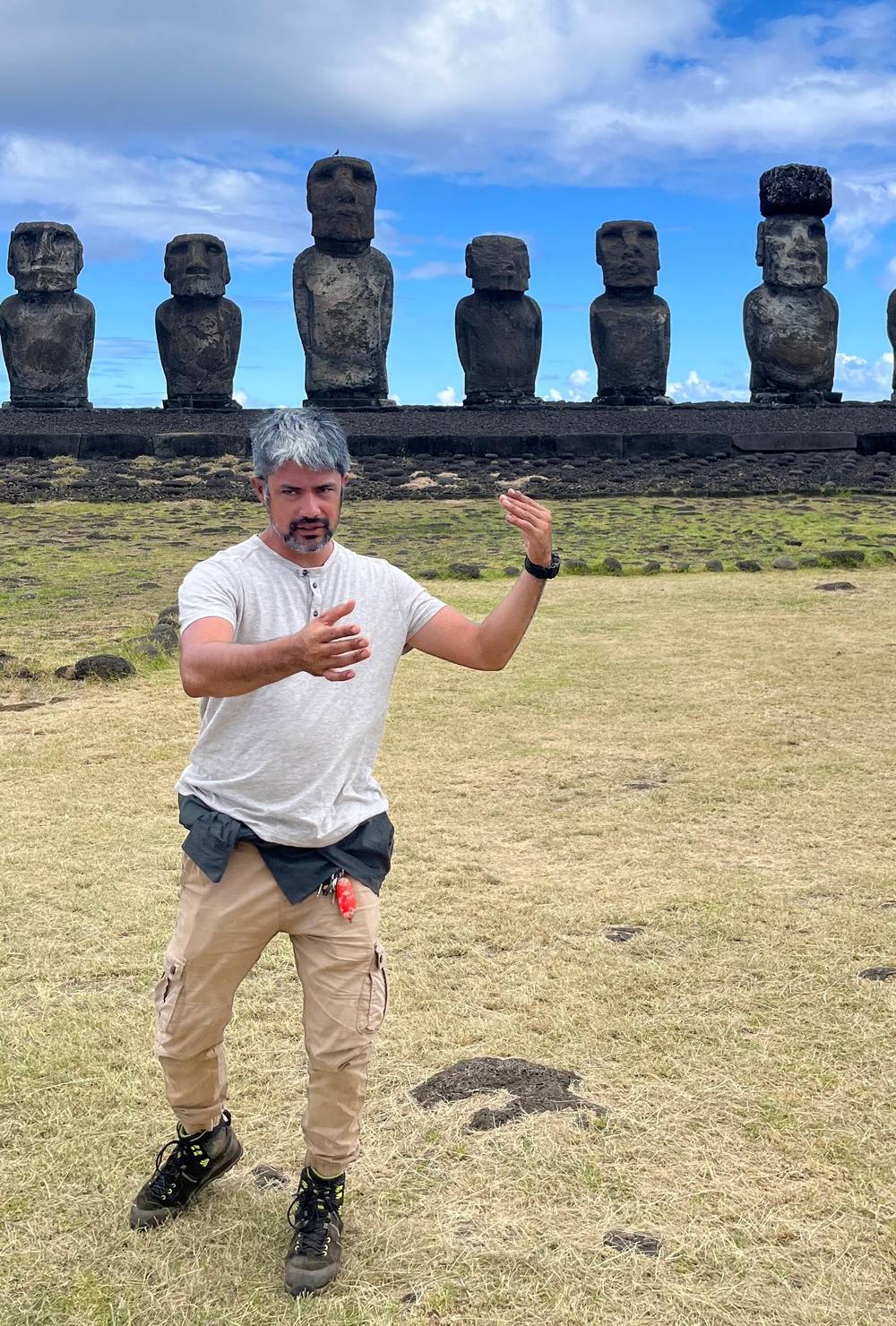
Rano Raraku has 386 moai, specifically 265 located on the outside and 121 on the inside.
Before you go
Rano Raraku lies about 25 minutes, or 18 km, by road from Hanga Roa,56 but you cannot simply drive up and walk in. Chile Travel stresses that you may go in only on a tour or in the company of a locally accredited guide,44 and every visitor needs a national park ticket. That ticket allows just a single entry to Rano Raraku, so plan the visit for good weather.4
Sites open from 09:00 once the rangers, the Muto'i Henua, have checked them,45 and a site may be marked in caution or closed for wind, rain or mud.57 The quarry also has public toilets, which most park sites lack.48 Never smoke: the park warns that wind and dry grass make the island highly vulnerable to fire,47 as the slope learned the hard way.
Stay on the path, keep the permitted distance and do not touch or lean on any statue.46 Sitting on a fallen moai for a photograph is forbidden too.58 These are not formalities: the stone is soft, the figures are ancestors to the Rapa Nui, and the damage from a single careless visitor can last for centuries.
Most visitors reach the quarry on a day tour of the east coast. The culture day sold on this site gives Rano Raraku a guided walk of 1 hour, followed by Ahu Tongariki, which the listing marks optional, then Te Pito Kura and free time at Anakena, with pickup in Hanga Roa, from $80.
If you want longer at the quarry, compare the alternatives. One 8-hour day spends 1 hour at Rano Raraku and adds a lunch stop of 45 minutes on site, from $142, while a private highlights tour of 6 hours gives the quarry 3 hours on its own, from $294. The extra time matters if you want to sketch, photograph or simply sit with the view.
Whichever you choose, ask questions. Guides from the island grew up with these statues, and many can tell you which figure belongs to which story. The quarry is where the moai stop being monuments and become the work of people, and a good guide makes the difference between seeing heads in the grass and understanding a whole civilization's craft.
FAQ
The National Monuments Council counts 265 on the outer slope and 121 inside the crater.2
The National Library measures it at 21.6 meters and more than 200 tons.18
Entry is only with an accredited local guide or as part of a booked tour.44
Each park ticket covers one visit to the quarry, so a second trip needs a new ticket.4
Chile Travel gives about 25 minutes, or 18 km, by road from town.56
Sources
More to read
Planning a day among the moai? Ask a real person here.