The landing
Anakena
North coast
- StoryHotu Matu'a's arrival
- CeremonyEvery 7 July
- AlsoSwimming
Your stop on the map
Answer in brief
The history of Rapa Nui runs from Polynesian settlers around 600 and the moai age of 1000 to 1500, through crisis, the birdman cult and the slave raids of 1862, to Chilean annexation in 1888 and Rapa Nui management of the park since 2017.
Key dates
Browse 20 stops
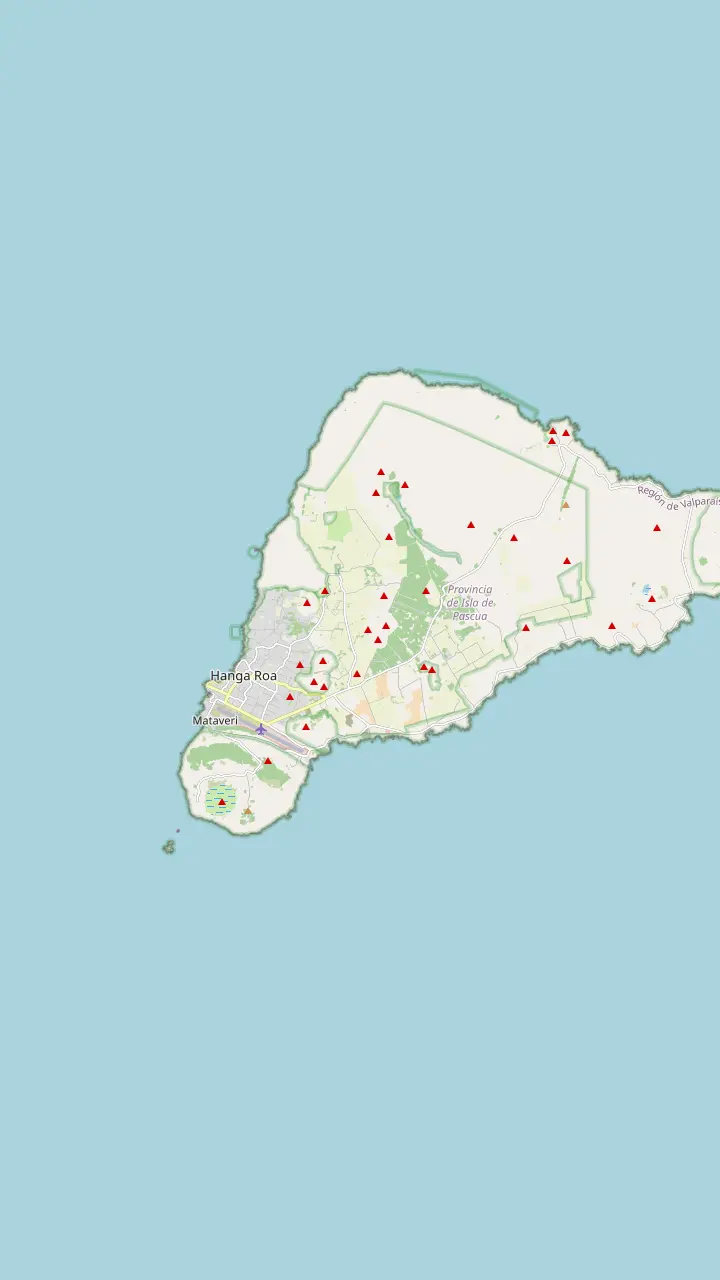
Start by picking a route; tap a pin or stop for its note and Google Maps.
White coral sand and palms, and the place where oral tradition says King Hotu Matu'a came ashore.
Google MapsThe lone moai beside Anakena beach, raised again by Thor Heyerdahl's team in one of the first documented restorations.
Google MapsThe stone village of the birdman cult on the rim of Rano Kau, with Motu Kao Kao, Motu Iti and Motu Nui out in the sea below.
Google MapsOne of the islets off Orongo and the goal of the yearly race for the first manutara egg.
Google MapsThree restored ahu and the remains of a village, steps from town; the park calls it one of the best places on the island for sunset.
Google MapsThe anthropological museum named after the priest Sebastian Englert; the Moai Tau, returned from Santiago, is shown here.
Google MapsTwo monumental ahu with fitted basalt walls that the park compares to Inca stonework.
Google MapsThe island's only town and the start of every tour; the airport sits beside it, and green turtles swim in the cove among the fishing boats.
Google MapsMataveri International Airport, reached by the direct flight from Santiago of 5 hours and 30 minutes.
Google MapsThe small harbor where the Moai Tau was landed from a navy barge on its return in March.
Google MapsVillage remains and toppled moai by the sea; the park links them to the civil wars of the 18th century.
Google Maps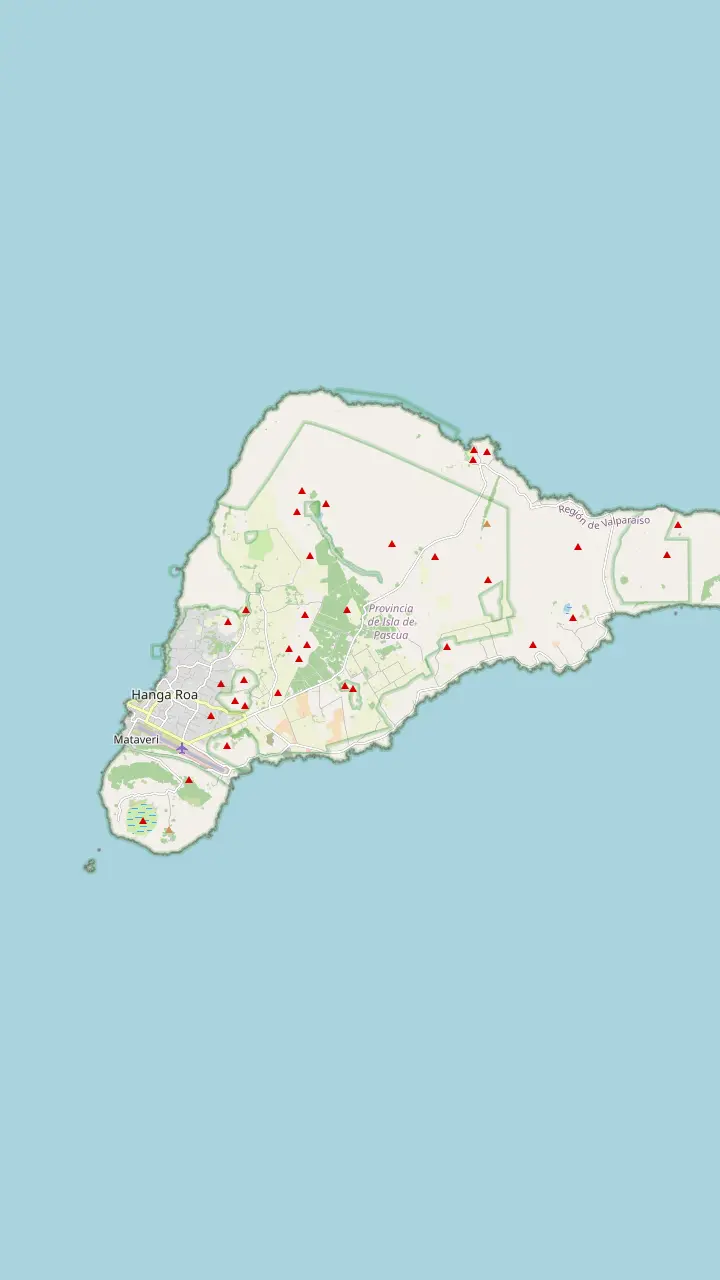
The island's only town and the start of every tour; the airport sits beside it, and green turtles swim in the cove among the fishing boats.
Google MapsThree restored ahu and the remains of a village, steps from town; the park calls it one of the best places on the island for sunset.
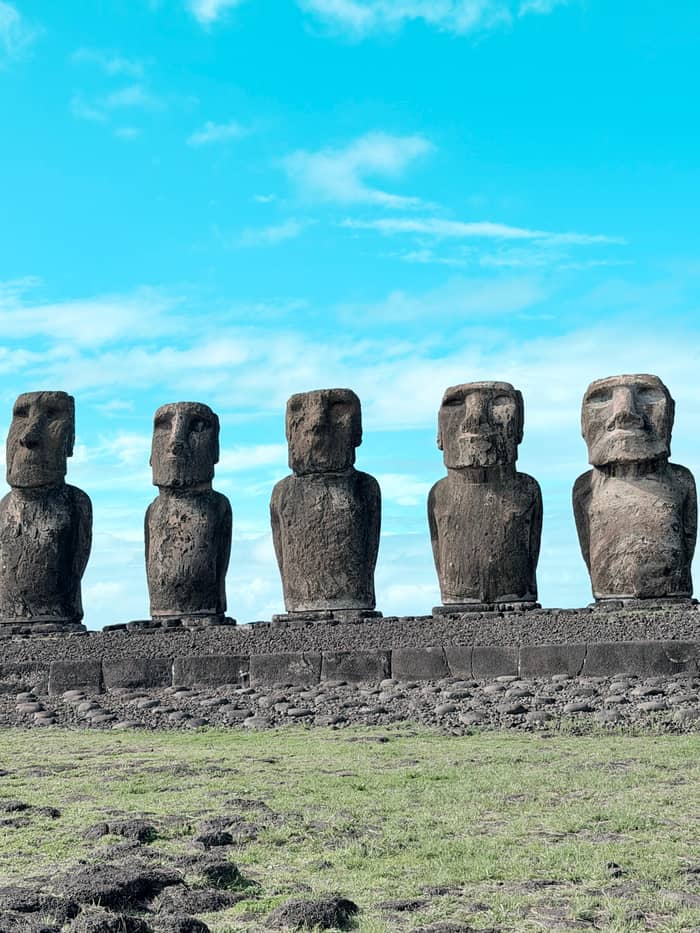
Google MapsSeven moai that look out to sea, aligned with the sun at the equinoxes, the platform linked to the explorers of the founding story.
Google MapsThe red scoria quarry where most of the pukao topknots were carved; unfinished pieces still lie there.
Google MapsTwo monumental ahu with fitted basalt walls that the park compares to Inca stonework.
Google MapsAn old village site with one of the longest platforms on the island and eight toppled moai.
Google MapsVillage remains and toppled moai by the sea; the park links them to the civil wars of the 18th century.
Google MapsThe volcano where the moai were carved: the park counts 400 statues in every stage of work on its slopes and in its crater.
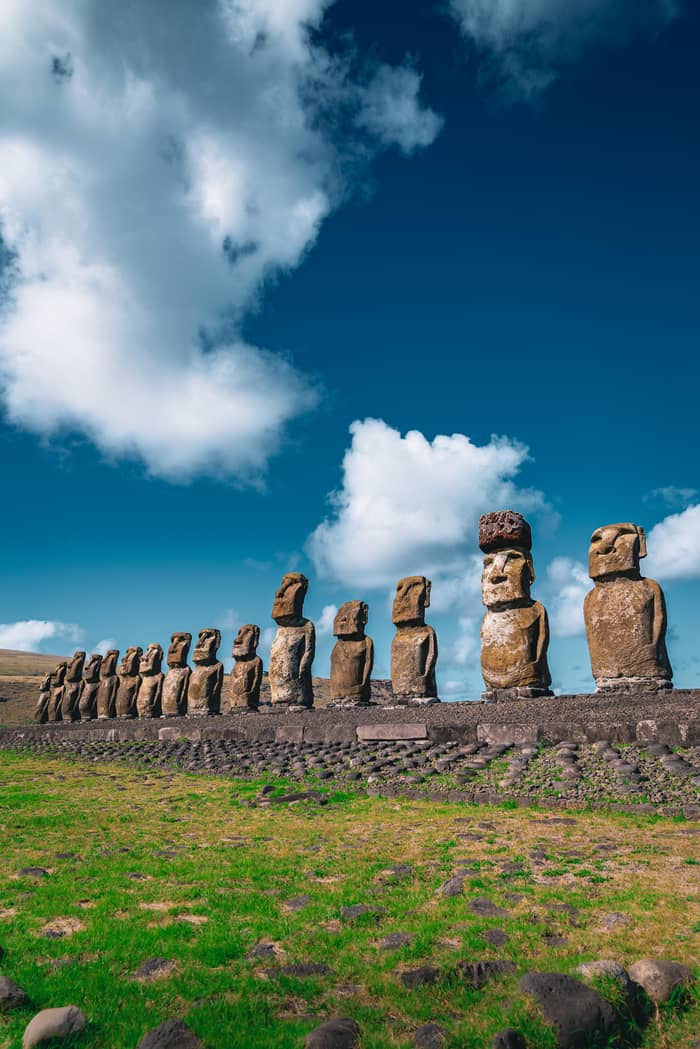
Google MapsThe largest platform on the island, 15 restored moai with their backs to the Pacific, and the classic sunrise spot.
Google MapsHome of Paro, the largest moai ever moved from the quarry, with its huge pukao.
Google MapsThe platform behind Anakena beach, whose moai still wear their red pukao.
Google MapsThe stone village of the birdman cult on the rim of Rano Kau, with Motu Kao Kao, Motu Iti and Motu Nui out in the sea below.
Google Maps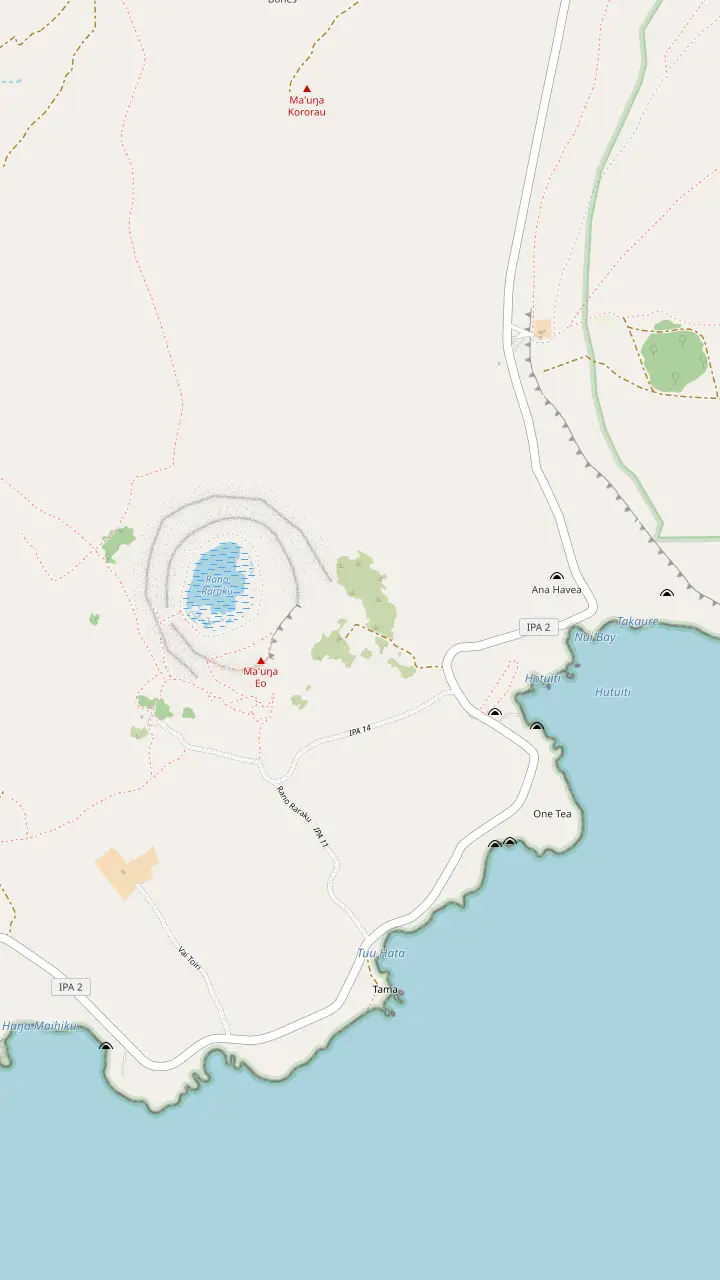
The volcano where the moai were carved: the park counts 400 statues in every stage of work on its slopes and in its crater.
Google MapsThe kneeling moai of Rano Raraku, also restored by Heyerdahl's team in 1955 and 1956.
Google MapsThe freshwater lagoon inside the Rano Raraku crater, reached on the walk past the half-buried heads.
Google MapsThe largest platform on the island, 15 restored moai with their backs to the Pacific, and the classic sunrise spot.
Google Maps
The largest platform on the island, 15 restored moai with their backs to the Pacific, and the classic sunrise spot.
Google MapsThree restored ahu and the remains of a village, steps from town; the park calls it one of the best places on the island for sunset.
Google MapsSeven moai that look out to sea, aligned with the sun at the equinoxes, the platform linked to the explorers of the founding story.
Google MapsThe island's only town and the start of every tour; the airport sits beside it, and green turtles swim in the cove among the fishing boats.
Google MapsThe volcano where the moai were carved: the park counts 400 statues in every stage of work on its slopes and in its crater.
Google MapsMap data: © OpenStreetMap contributors
Voyagers who found the most remote island of Polynesia, a statue-building age, a crisis, a new religion, then slave ships, a sheep ranch and a long fight to take the island's heritage back.
Editorial team, easterislandtour.quest · Updated November 11, 2026 · Takes 6 min
The essentials
Long before anyone called it Easter Island, Rapa Nui was found by Polynesian navigators. Chile's statement of outstanding universal value for UNESCO says the island was settled around the middle of the first millennium AD by a small group from Eastern Polynesia,6 and the National Library of Chile places the arrival of settlers from the Marquesas around the year 600, carrying sweet potato, taro, yam, banana, sugar cane, the chicken and the Polynesian rat.1
Rapa Nui tradition remembers the leader by name. According to oral history the voyage was led by the ariki Hotu Matu'a, founder of the ruling lineage, whose sons became the ancestors of the island's tribes.7 He landed, the tradition says, on the beach of Anakena on the north coast,8 and the Rapa Nui people still mark that arrival every 7 July with a ceremony at the beach they call Hanga Rau.9
In the same tradition Tu'u Maheke, the first Rapa Nui, was born at Hanga Rau.10 Another story links the seven moai of Ahu Akivi to the first explorers sent ahead by Hotu Matu'a to scout the island.11 To understand Easter Island before the moai, start there: a seafaring people who arrived with plants and animals, organized by lineage, and with a founding story they still tell today.
Outsiders arrive
| Year | Who | What happened |
|---|---|---|
| 1722 | Jacob Roggeveen | Arrives at Easter and names the island |
| 1770 | A Spanish expedition | Claims the island for the crown |
| 1774 | James Cook | Notes the monuments and the islanders' poverty |
From the National Library of Chile's chronology of Rapa Nui.3,23,24
Ceremonial building began early. The National Library dates the first platforms to around the eighth century AD and names Ahu Tahai, built in 713 AD, as the oldest.12 Around the year 1000, the same source says, Rapa Nui society reached its peak and its population grew fast, and the building of ceremonial centers to the ancestors with their great stone statues began in earnest.16
So when were the moai on Easter Island built? Chile's conservation center gives the clearest answer, naming the Ahu-Moai period from 1000 to 1500 AD as the time when the statues were carved from the slope of Rano Raraku.2 Chile's UNESCO statement describes the technical skill as most intense between the eleventh and seventeenth centuries,17 a broad window that covers the great statue age.
Society in these centuries was hierarchical and organized by lineages, each holding its own territory. The population is estimated to have reached 10,000 people,18 and the library explains that rivalry between lineages drove the statues to grow ever larger.19 Each platform was the face of a clan toward its land, which is why most moai stand with their backs to the sea.20
Growth had a price. The library tells how almost total deforestation left the islanders unable to build boats that might have relieved the pressure on scarce food.28 Its chronology dates the start of conflict between lineages to 1680, a period that led to the destruction of a large share of the moai,29 and the conservation center calls the years from 1500 to 1722 the Huri Moai phase of social breakdown and war.30
In that period almost all the statues on the platforms were toppled and broken.31 A new order rose from the crisis: the cult of Make Make, the creator god, and the tangata manu, or birdman, ceremony, in which the lineages competed each year for political power.27 Its center was Orongo, a village of stone houses on the rim of the Rano Kau crater facing the islets offshore.32
The contest was dangerous. Chile Travel describes the race to bring back an intact egg of the manutara, a seabird, from the islet, and notes that many competitors died in it.33 Orongo holds about 50 elliptical houses,34 and the rocks at Mata Ngarau carry the island's richest birdman petroglyphs,35 part of some 1,000 rock-art sites recorded across Rapa Nui.36
Plan by interest
Start from the part of the island's past that pulls you most.
If The birdman cult and Orongo
The Orongo to Ana Te Pahu day
Orongo, Vinapu, Puna Pau, Akivi and a cave in 7 hours.
If Only Orongo, in a morning
The birdman half day
Orongo, the Rano Kau crater and Vinapu in 3 hours.
If The moai age and the quarry
The culture day
A full guided day through the quarry and the eastern platforms, 8 hours.
If The founding story
Anakena
Where tradition says Hotu Matu'a landed.8
If The modern story
The museum in Hanga Roa
Where history happened
The first recorded European visit came in 1722, when the Dutch navigator Jacob Roggeveen reached the island on Easter Sunday, which is how it got the name the outside world still uses.3 The arrival marked the end of centuries of isolation that Chile's UNESCO statement sees as central to the island's unique culture.63
Others followed. In 1770 a Spanish expedition took possession of the island for the crown,23 and in 1774 Captain James Cook called, impressed by the monuments and struck by how poor the islanders seemed.24 These early visitors left drawings and journals that historians still use, though each saw the island through his own expectations.
The voyages brought more than visitors. The UNESCO statement describes contact with Europeans in the eighteenth century arriving when the island's natural resources were already exhausted and its society in crisis.63 What followed in the next century was far worse than anything the eighteenth-century ships had brought.
Go with a guide
Shared tours through the island's past.
Compare all 3 options
Shared tours through the island's past.
≈
View≈
View≈
ViewStarting prices on GetYourGuide, exchanged at the ECB reference rate. The booking page gives the exact price.
Key dates
Around 600
Voyagers from the Marquesas reach the island.1
713 AD
Ahu Tahai, the oldest dated ahu.12
1722
A Dutch ship arrives on Easter Sunday.3
1862
Islanders are taken to the guano works of Peru.13
1888
Chile takes possession of the island.14
1966
Rapa Nui returns to the Chilean state.15
2017
The Rapa Nui take over the park.5
In 1862 a fleet of slave ships arrived to seize islanders and take them to dig guano on the coast of Peru.13 After French and British protests a repatriation was ordered, but only about fifteen of those taken came home, and they brought smallpox, which proved lethal for the people of the island.64
Missionaries of the Sacred Hearts arrived in 1864,65 and in 1870 the Frenchman Dutroux-Bornier came to take over the land, while his partner John Brander shipped workers to plantations elsewhere, leaving only 175 Rapa Nui on the island.21 Chile's UNESCO statement sums up the result: colonization, livestock, disease and above all slavery cut the population to little more than a hundred.22
Knowledge died with the people. The same statement links this collapse to the loss of the rongorongo script, which has still not been deciphered.66 The same decade, a moai left the island: in 1870 the corvette O'Higgins carried one to Santiago, the statue now known as Moai Tau.67
Video
Fall of Civilizations on YouTube · The video only starts loading on your tap.
It crystallized in the cult of Make Make, the creator god, and in the ceremony of the tangata manu, the bird man, in which the different lineages competed each year for political power.
Before a history day
Easter Island became part of Chile on 9 September 1888,4 when Commander Policarpo Toro of the ship Angamos took possession for the Chilean government.14 The same year the island was turned into an enormous sheep ranch, and islanders who had lived from fishing became tenants of the foreign companies that ran it.68
In 1917 the island was placed under the naval authority of the Maritime Territory based in Valparaiso,69 and in 1936 the ranching company gave up its claims in return for a lease of 20 years.70 Protection of the archaeology began on paper in 1935, when the national park was created on 16 January and the island declared a Historic Monument on 23 July.71
Systematic archaeology arrived with Thor Heyerdahl's expedition in 1955,72 whose team also made the first documented restorations of moai.54 When the lease ended, Rapa Nui returned to the Chilean state in 1966,15 and tourism and a new value placed on the island's heritage began to reshape the relationship between its people and the state.
Modern protection took shape over the following decades. The National Library records that the park was renamed Rapa Nui National Park in 1976, covering 7,130 hectares, about 43% of the island,73 and CONAF dates both its present boundaries and its UNESCO World Heritage listing to 1995, the listing on 8 December.74 The island museum, founded by decree on 10 October 1973, keeps the collections of Father Sebastian Englert.25
On November 23, 2017 management of the park passed formally to the Rapa Nui people, and the Ma'u Henua indigenous community has administered it ever since.5 The handover rests on a concession of 50 years approved in an indigenous consultation in which more than 86% voted in favor,75 and the community now counts 2,500 members.76
History is also coming home. After 152 years in Santiago, the basalt Moai Tau has returned to the island,41 under a program to bring back ancestral remains and sacred objects.77 Each February the Tapati festival fills two weeks with dances, contests and body painting,78,62 proof that the culture you read about on this page is very much alive.
FAQ
The Dutch navigator Jacob Roggeveen reached it on Easter Sunday 1722.3
The Rapa Nui community has run the national park since 2017.5
The rongorongo script was lost in the collapse and is still undeciphered.66
Sources
More to read
Planning a day among the moai? Ask a real person here.